“Relating well” across generations: A practical application of tikanga and Te Tiriti o Waitangi in Kāwhia Moana
DOI:
https://doi.org/10.15286/jps.135.1-2.45-58Keywords:
tikanga, future generations, obligation, environmental problemsAbstract
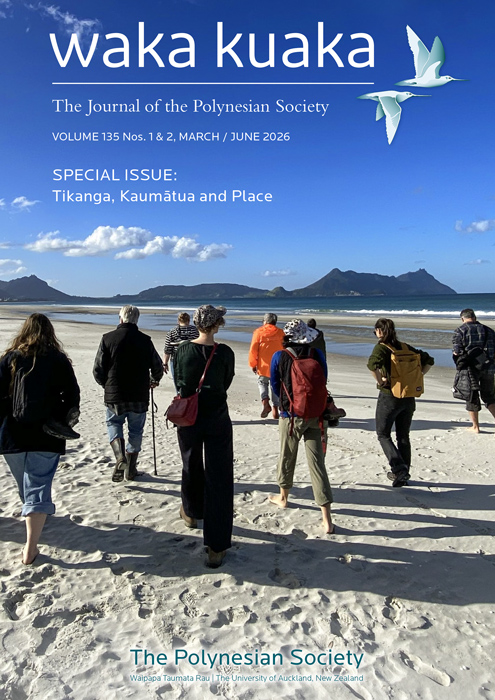
Tikanga Māori (Māori customs, protocols, law) has practical application for communities to motivate long-term and sophisticated responses to environmental problems. A core prescription of tikanga is to “relate well” within an expansive and inclusive web of relationships that extend across space and time. Accordingly, environmental problems are understood and addressed as socioenvironmental problems that affect the web of relationships between people within communities and their relationships with the environment—into the future. These themes will be explored briefly by considering how the community in Kāwhia, Aotearoa New Zealand, has responded to concerns about the damage caused by vehicles on the beach adjacent to Maketū Marae and the “resting place” of the Tainui waka (great migration canoe). The response, led by the Marae but involving the wider community, is arguably also a practical application of Te Tiriti o Waitangi and its prescription to “relate well”.
Additional Files
Published
How to Cite
Issue
Section
License
Copyright © 2025 by the Polynesian Society (Inc.)
Apart from any fair dealing for the purposes of private study, research, criticism, or review, as permitted under the Copyright Act, no part of this publication may be reproduced by any process without written permission.
Inquiries should be made to:
Dr Marcia Leenen-Young, Editor
The Polynesian Society
c/o School of Māori and Pacific Studies
The University of Auckland
Private Bag 92019, Auckland
New Zealand
email: m.leenen@auckland.ac.nz